

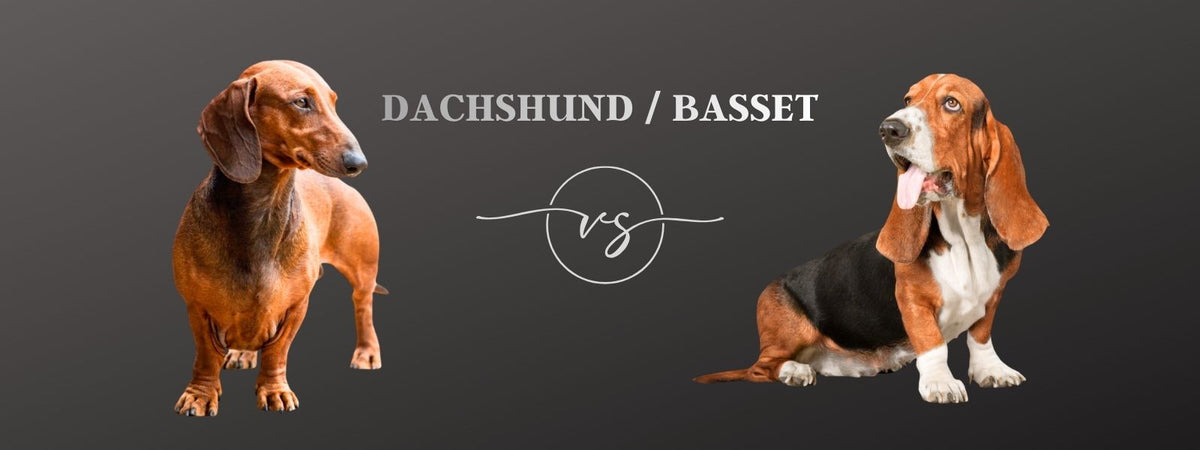
What is the difference between a basset and a dachshund? Sausage dogs and bassets look so much alike that many people confuse them. The same long silhouette, the same short legs, the same slightly philosophical look. However, behind this common appearance hide two very different breeds, with a distinct history, morphology, and temperament.
This article helps you clearly understand what separates a basset from a dachshund, relying solely on reliable sources.
Basset & Dachshund: two very different origins despite a similar silhouette
The first difference between a basset and a dachshund lies in their origin.
According to the Fédération Cynologique Internationale (FCI, Official Standard, 2024) :
-
The Dachshund (FCI Group 4) comes from Germany.
It was developed for badger hunting.
Source: Fédération Cynologique Internationale, Standard no. 148, 2024 -
The Basset Hound (FCI Group 6) comes from France and the United Kingdom.
It descends from the Bloodhound, selected for hunting on foot.
Source: Fédération Cynologique Internationale, Standard no. 163, 2024
Both breeds were therefore created for hunting, but not the same type of hunting and not in the same culture.
This is what specifically explains the difference in gait and character.
Morphology: a dachshund is long and energetic, a basset is massive and heavy
Even if both have short legs, their bodies do not function the same way at all.
Size and weight
-
Dachshund:
• 5 to 11 kg depending on variety
• Long, muscular body, very horizontal topline
• Light weight and dynamic silhouette -
Basset Hound:
• 23 to 30 kg
• Very broad chest, massive bone structure
• Slow and heavy gait
Weight alone shows the extent of the difference. A basset can weigh 3 to 4 times the weight of a dachshund!
Legs and posture
Both breeds share the dwarfism gene (chondrodysplasia), which explains their short legs.
However:
-
The sausage dog has short but straight legs.

-
The basset has even shorter legs, often turned outward more, with very heavy bone structure.

Ears and head
-
Dachshund: medium-sized, hanging ears, elongated head.
-
Basset Hound: very long, hanging ears, loose skin that forms folds.
The coats of the dachshund and the basset: two totally different worlds
Even if dachshunds and bassets share a similar look, their coats have nothing in common. The official standards describe two very distinct worlds, both in texture and maintenance.
The Dachshund: three coat types, an impressive variety of colors
The dachshund exists in three coat varieties:
-
-
Short, smooth, tight against the body.
-
Firm texture.
-
Easy maintenance: a simple brush-down is enough.
-
-
-
Silky, smooth hair, with feathering on the ears, belly, and tail.
-
Requires regular brushing to avoid knots.
-
Provides a more elegant and flowing look.
-
-
-
Thick, coarse hair, with a dense undercoat.
-
Characteristic beard on the muzzle.
-
More technical maintenance, with occasional hand-stripping recommended.
-
Dachshund colors
For dachshund colors, the choice is varied! (are you an expert on this dog breed's coats? 😉) :
-
black and tan,
-
red,
-
wild boar (brindle/grizzled),
-
chocolate and tan,
-
cream,
-
merle (dapple)
-
brindle for some lineages.
The Basset Hound: a short, dense, and uniform coat
The basset hound has only one type of coat.
"Short, smooth, and dense coat, providing good protection."
-
The coat is thick but easy to maintain.
-
The undercoat is present but less marked than in a wire-haired dachshund.
-
The texture is naturally heavier and oilier, which protects the dog from cold and rain during long hunting walks.
Basset hound colors
The FCI specifies that the basset hound is traditionally:
-
bicolor (usually white and red/lemon),
-
tricolor (black, white, tan),
-
in combinations always inspired by the Bloodhound.
Dachshund vs Basset Temperament: two almost opposite characters
Even if every dog is unique, the official standards provide reliable tendencies.
✅ Dachshund

According to the FCI:
"Lively, courageous, sometimes stubborn."
The dachshund is energetic, expressive, intelligent, and headstrong. It retains a very pronounced hunting instinct, loves to follow a trail, and take initiative.
✅ Basset Hound

According to the FCI:
"Calm, sweet, affectionate."
The basset is much slower, laid-back, and known for its great kindness and patience. It can be stubborn but remains less high-strung than a dachshund.
Daily needs: the dachshund expends energy, the basset accompanies
Physical activity
-
The dachshund needs energy: frequent short outings, mental stimulation, scent games.
-
The basset hound prefers long, quiet walks.
Health
-
The Dachshund is predisposed to back problems (intervertebral disc disease).
-
The Basset has joint risks and issues with being overweight.

Friendliness: two adorable dogs but not identical
Dachshund: an intelligent dog but sometimes suspicious and territorial
According to the Fédération Cynologique Internationale, the dachshund is described as:
"Lively temperament, courageous, possessing a strong character."
This liveliness is often accompanied by a form of natural vigilance.
The dachshund, having been selected for centuries to work alone underground (badgers, foxes), retains a highly developed protection instinct.
This can manifest as:
-
a tendency to monitor its environment,
-
a wariness towards strangers,
-
a hint of territoriality,
-
barking to signal anything that seems unusual to it.
The dachshund is not aggressive, but it observes, it analyzes, and it may keep its distance.
With good socialization from a very young age, this trait balances out very well.
Basset Hound: a temperament of great gentleness
The Basset Hound, according to the FCI is described as:
"Affectionate, calm, friendly."
This character is explained by its historical selection:
The Basset was a hunting dog on foot, always in a pack, with a slow and steady work pace.
Over time, priority was therefore given to:
-
patience,
-
gentleness,
-
tolerance,
-
sociability with both humans and other dogs.
It is recognized as one of the most accessible family dogs, notably because it:
-
easily accepts visitors,
-
adapts to children,
-
does not react abruptly,
-
has a great capacity to stay calm.
Most official organizations even emphasize that the Basset is rarely territorial.
Final paw
The Basset and the Dachshund resemble each other in size and silhouette, but everything else changes:
-
Different origin
-
Opposing weight and morphology
-
Distinct temperament
-
Different daily needs
In short, the Dachshund is lively and athletic. The Basset is calm and sturdy.
Two short-legged dogs, but two completely different worlds.
The Teckelshop team - 💚
This content is provided for informational purposes only and does not under any circumstances constitute veterinary advice. Teckelshop.fr disclaims all liability for actions taken on the basis of this information. Consult a veterinarian for personalized advice on the care to provide for your animal.


Leave a comment
All comments are moderated before being published.
This site is protected by hCaptcha and the hCaptcha Privacy Policy and Terms of Service apply.