

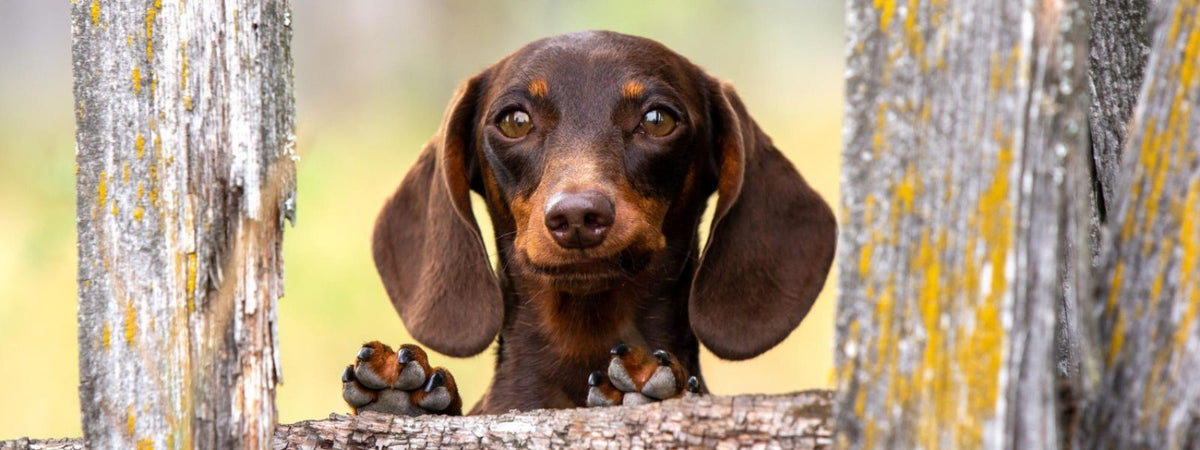

The dachshund, with its elongated silhouette, assertive character, and overflowing energy, is a dog that is as endearing as it is very turbulent! Many of you are asking yourselves the question of when dachshunds become calmer. Between its playful temperament, its sharpened hunting instinct, and its unconditional attachment to its owner, this little sausage dog sometimes gives the impression of being at full power from morning till night.
As with all breeds, a dachshund's behavior evolves over time. If you put in the energy, patience, and heart, you will quickly observe that your little fur ball will soon develop a calmer spirit.
Why are dachshunds often so dynamic?

To understand when a dachshund becomes calmer, it is essential to know that it is not a "classic" companion dog.
According to the origins of the dachshund, this little 4-legged sausage was, above all, a hunting dog, used to flush out badgers and foxes.
Its history explains:
-
Its impulsiveness;
-
Its tenacity;
-
Its need for exploration;
-
Its tendency to bark;
-
Its natural energy.
A dachshund that does not get enough physical and mental exercise will have much more difficulty settling down. It is a dog that is as intelligent as it is stubborn and likes to understand why it has to obey.
At what age do dachshunds become calmer?
You have just adopted a dachshund puppy, kaninchen, miniature, or standard, and barely arrived at your home, is it already giving you a hard time? In general, a dachshund begins to calm down around 2 to 3 years old, when its physical and emotional maturity is reached.
The baby period, from 0 to 6 months
During its first months, the dachshund explores its environment without any restraint. It nibbles, runs, plays, and tests limits.
At this stage, it is normal for it to be very active, with energy that is difficult to channel. This period is for building fundamental learning.
The turbulent adolescence, from 6 to 18 months
During this adolescent period, the dachshund can show:
-
A surge of energy;
-
A tendency toward disobedience;
-
A strengthening of its primitive instincts;
-
A stronger reactivity to stimuli.
This is the most intense phase, the one where owners really wonder when the dachshund will calm down.
Adulthood, from 2 to 3 years old
Even if dachshunds retain their strong-willed character, they gradually manage to channel and master their energy. As adults, they become more emotionally stable, learn to better manage their impulses, and adopt a more composed and serene behavior.
Maturity, after 5 or 6 years
From this age, dachshunds generally become more zen and peaceful.
They appreciate rest times more and show fewer destructive behaviors. Their character stabilizes while keeping their curious and lively soul.
These periods indeed show that the dachshund evolves over time. But, if you do not meet its physical and psychological needs, your pooch will struggle to find serenity and will not stay quiet, even as an adult.
Find our article: what dachshunds don't like?
What factors influence calmness in dachshunds?

Certain factors can influence the calmness and tranquility of your dachshund.
The variety, sex, and neutering raise differences in behavior, being gentler or, conversely, more agitated. However, your support is certainly the factor that will determine the future temperament of your dog.
Dachshund education and socialization for more peace of mind
A miniature dachshund socialized from a very young age will tend to become calm sooner. Training a dachshund includes key learnings such as:
-
Leash walking;
-
Recall;
-
Frustration management;
-
Acceptance of being alone;
-
Regular mental exercise.
This little spirited dog full of energy needs, from the moment it enters your life, to be accompanied in its education to understand the rules of your home.
Living environment for more serenity
It is no longer a secret, the dachshund is a hyperactive dog that needs daily physical activity.
When you adopt a dachshund, you will need to be patient and ensure it never gets bored. A dachshund will be more alert, more relaxed, and calmer if it lives in a stimulating environment. There are dozens of ways to occupy your dachshund.
How to help dachshunds become calmer and more tranquil?

Even if age plays a capital role, the calmness of a dachshund depends above all on the habits you put in place.
Providing enough physical exercise to induce calm
Contrary to what some think, the dachshund is not just a "little apartment dog". It needs:
-
Long minutes of walking per day; (minimum 30 mins)
-
Periods of freedom in safe terrain;
-
Throwing and search games.
Do you know how many kilometers a dachshund can walk? Do not be fooled by its small size, this 4-legged sausage might just surprise you!
Mental stimulation to teach patience
Intellectual work tires a dog more than physical exercise. It also allows for nourishing the psychic needs of the dachshund and teaching it self-control, confidence, and resignation. There are several ideas to keep it mentally busy such as:
-
Occupation toys;
-
The snuffle mat;
-
Tracking games;
-
Learning new commands;
-
Stimulation games.
Chewing is also an essential and instinctive need of the dog that it is essential to meet. To help your dachshund calm down, offer it chew treats, deer antlers, or chew toys. It will be less inclined to attack your furniture or even your socks / ankles!
Establishing a stable routine to teach zenitude
A dachshund reassured by a routine becomes calmer. To ensure this, you can establish a routine for:
-
Meal times;
-
Walking times;
-
Rest times.
Working on managing solitude to cultivate peace
The Dachshund can feel strong anxiety when separated from its owners. Teaching it gradually to stay alone helps reduce its agitation and stress.
Reinforcing calm naturally to teach gentleness
Rewarding calm behavior is much more effective than punishing excitement. It is recommended to:
-
Reward your dachshund when it lies down spontaneously;
-
Praise your little dog when it remains calm during a visit;
-
Reinforce the quiet moments of your little companion.
Making a dachshund happy means meeting all of your pet's needs to serenely enjoy the bond that unites you. The dachshund is a very loyal little dog and overflowing with affection toward its owners. So, it's up to you to return the favor and it will be absolutely calm!
Final Paw
Even if most dachshunds calm down naturally around 2 to 3 years old, each dog is unique. Their energy, character, hunting instinct, and particular attachment to humans make them lively but balanced dogs, provided they are understood.
With consistent education, an adapted routine, and stimulating activities, your dachshund will naturally become calmer, without ever losing the sparkling personality that makes all its charm.
And when certain situations seem more complex, the guidance of a dog trainer or professional animal behaviorist can make all the difference. These experts help to better decode your dog's needs and implement adapted solutions, while respecting their temperament.
The Teckelshop team - 💚 last modified on 05/22/2026
This content is provided for informational purposes only and does not under any circumstances constitute veterinary advice. Teckelshop.fr declines all responsibility for actions taken based on this information. Consult a veterinarian for personalized advice on the care to provide for your pet.


1 comment
Gangloff
Bonjour, possesseur d’une femelle teckel c’est une race de chien bien à part, plus intelligente que beaucoup le pense.
En effet si elle n’a pas envie de faire une tâche ce n’est pas par entêtement mais par intelligence.
ll faut aussi bien s’assurer que le comportementalisme que vous choisirez connaisse cette race de chien et ne rentre pas dans les généralités.
Chiquita marche entre 250 et 300km par jour c’est ma chérie!!!
Leave a comment
All comments are moderated before being published.
This site is protected by hCaptcha and the hCaptcha Privacy Policy and Terms of Service apply.