

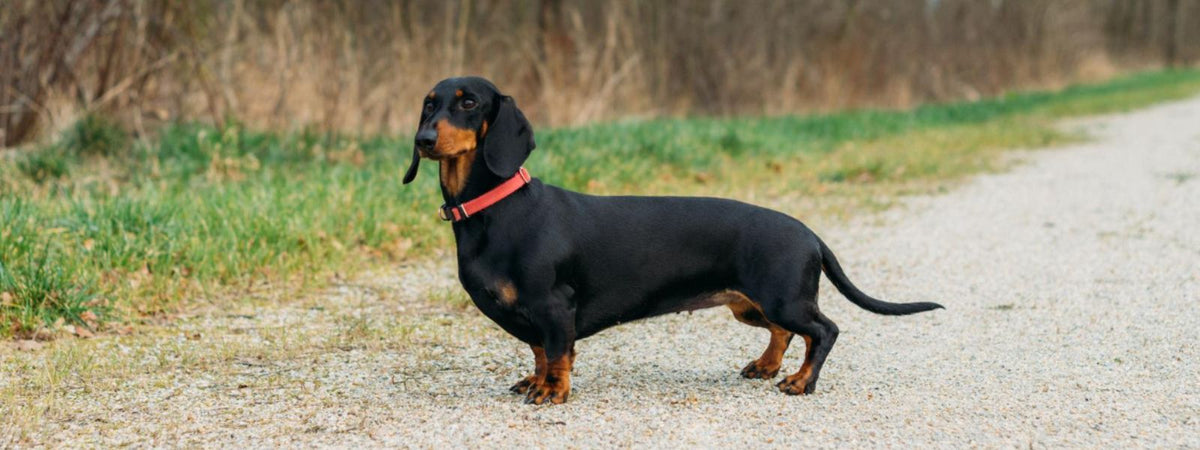

For the dachshund, as with any other dog breed, walking is an essential activity for maintaining good health. But what about walking for several kilometers?
Are you planning to take your dachshund on a long hike soon? But you're wondering: are they actually capable of covering long distances? Discover the answer to your question in this article.
What distance can a dachshund cover?
The dachshund is a breed that possesses great endurance despite its small size. In principle, a healthy adult in peak physical condition can walk an average of 10 km (between 8 and 12 km).
As you have likely gathered, the health status of your dachshund is the first factor in determining whether or not they will be able to cover long distances. However, it should be noted that other factors must also be taken into consideration to determine if your doxie is cut out for hiking:
- Their age: sustained physical exercise like hiking should only be considered after the age of 1 year. The same applies to senior dachshunds.
- Their lifestyle: a walk of several kilometers is reserved only for dogs that have followed a good training regimen, meaning that walking has been gradually introduced into their lifestyle over a period of time.
- The type of dachshund: the wire-haired dachshund is known to be more robust and athletic than other types of dachshunds (long-haired and smooth-haired).
However, it is important to note that this distance of about 10 km is the average distance that a doxie can manage occasionally during a hike, not on a daily basis.
For daily short walks, these should be limited to one hour of walking for adult dachshunds, ideally split into a 30-minute session in the morning and 30 minutes at the end of the day.
Regarding dachshund puppies, two walks of 10 to 20 minutes are more than enough. As a general rule, professionals recommend 5 minutes of walking per month of age.
For example: for a 4-month-old baby dachshund, a daily outing of 20 minutes divided into two walks is recommended.
Note that during outings, you should avoid making your pup run and opt for a moderate pace. Due to their short-legged build and long back, dachshunds, especially miniature dachshunds, are simply not built for running.
The benefits of hiking for the dachshund

As a reminder, the dachshund is an energetic breed that requires daily physical activity to burn off excess energy. Therefore, choosing a dog like the dachshund as a pet means you are certain to have to provide them with daily exercise to maintain their health.
Covering a few kilometers is a good exercise choice to help them expend energy, but also to avoid any risk of health problems like obesity, which is often linked to a sedentary lifestyle.
Walking can also help them develop muscle to protect their back from potential injuries caused by overweight issues. Not to mention that you are giving them the opportunity to discover new environments where they can tap into their hunting instincts.
Nevertheless, keep in mind that the number of kilometers covered must be proportional to their health, age, and lifestyle habits.
The risks of overly intense walking
Beyond fatigue, covering several kilometers is harmful to a dachshund's health.
For a young dachshund (under 1 year old), long, repetitive walks risk damaging their joints, which are still growing. This is most often referred to as muscle inflammation (myositis). In an adult doxie, fatigue caused by a walk that is too long can degrade their health.
Here are some warning signs that your dog is exhausted and it is time to cut the walk short:
- Excessive panting.
- Difficulty breathing.
- Red gums.
- Vomiting.
- A slow and heavy walking pace;
- They take advantage of every stop to sit or lie down.
Preparing for a hike

Before considering a multi-kilometer hike with your doxie, you must necessarily train them by doing daily walks and gradually increasing the duration and distance.
A few days before leaving, don't forget to consult your veterinarian to see if they are in good physical condition for such an adventure. Also ensure you have the necessary equipment for hiking (leash, carrier bag, collar, harness...).
Furthermore, the choice of environment is an important element to consider. Prefer shaded trails and avoid overly steep paths as much as possible. Also, check the weather. Ensure it is neither too hot nor too cold.
Along the way, plan for short breaks during which you can hydrate them and give them small treats so they can recharge their energy before moving on.
If you notice any of the signs mentioned above, do not force them to continue and carry them in their carrier bag until you reach your destination.
Final paw
In principle, the dachshund is not exactly a great hiking dog. Despite being full of energy and loving physical activity, they are not really predisposed to covering long distances, primarily due to their build.
For outdoor exercises like hiking, these should only be done regularly following a vet's recommendation and only if your little one has received good progressive training before piling on the kilometers.
The Teckelshop Team - 💚 last modified on 07/20/2026


2 comments
Martinis
Bonjour, nous possédons deux soeurs teckel kaninchen de 1 ans une des deux est très endurante pendant les promenades (env. 4km ) elle ne marche pas elle cour impossible de la faire ralentir elle déborde d’énergie ,l’autre au contraire est la petite mémère qui fatigue vite.
THEROND
Bonsoir, vos articles sont tjs interessant.
Est ce que le teckel (poils longs) aime l’eau. ?
Je n’ai pas essayé avec la mienne
Merci
Leave a comment
All comments are moderated before being published.
This site is protected by hCaptcha and the hCaptcha Privacy Policy and Terms of Service apply.