


Do you have a dachshund? Are you wondering about the origins of this magnificent breed? Do you want to understand the birth of its natural instinct?
Here is everything you need to know about the origin of the dachshund in this new blog post 🐶
What is the History of the Dachshund Breed?
The name "Dachshund" literally means badger dog in German, derived from the German words "Dachs" and "Hund".
In modern Germany, the dachshund is more commonly called "Dackel" or "Teckel", with "Teckel" being more commonly used by hunters.
The dachshund is also known as a "Doxie" or sausage dog, due to its long and thin body, which looks like a sausage 😊
The dachshund's front paws are paddle-shaped, which helps it dig extensively and can be particularly useful for hunting and chasing badgers, rabbits, and other mammals.
The dachshund's deep chest gives it increased lung capacity, which is useful when hunting underground.
Official origin of the dachshund

The origin of the dachshund dates back to 15th-century Germany, where two sizes of dachshunds were bred primarily for hunting.
The standard dachshund was bred primarily to sniff out and flush out badgers and other similar mammals living in burrows, while the miniature dachshund was bred primarily for hunting rabbits.
In the United States, dachshunds were also used for hunting prairie dogs and tracking deer 🦌
What comes to mind today when we think of dachshund strains is how they bravely enter the dens of badgers and foxes, then bark to let their human hunting friend know where they are.
But these little hunters are also known for tracking in packs when the prey is much larger than them, such as the wolverine (a fierce, solitary, and powerful mammal) as well as wild boar.
Their usual prey, however, remains rabbits, foxes, badgers, and other smaller animals.
Surprisingly or not, this small dog was also used for deer hunting, searching for wounded animals, and sometimes, following accidents and tragedies, searching for injured or dead persons.
Finally, the last of the breed is the Kaninchen dachshund (meaning rabbit in German), introduced in Europe in the 19th century to hunt and flush out smaller prey due to its miniature size.
Birthplace of the First Dachshund Dogs
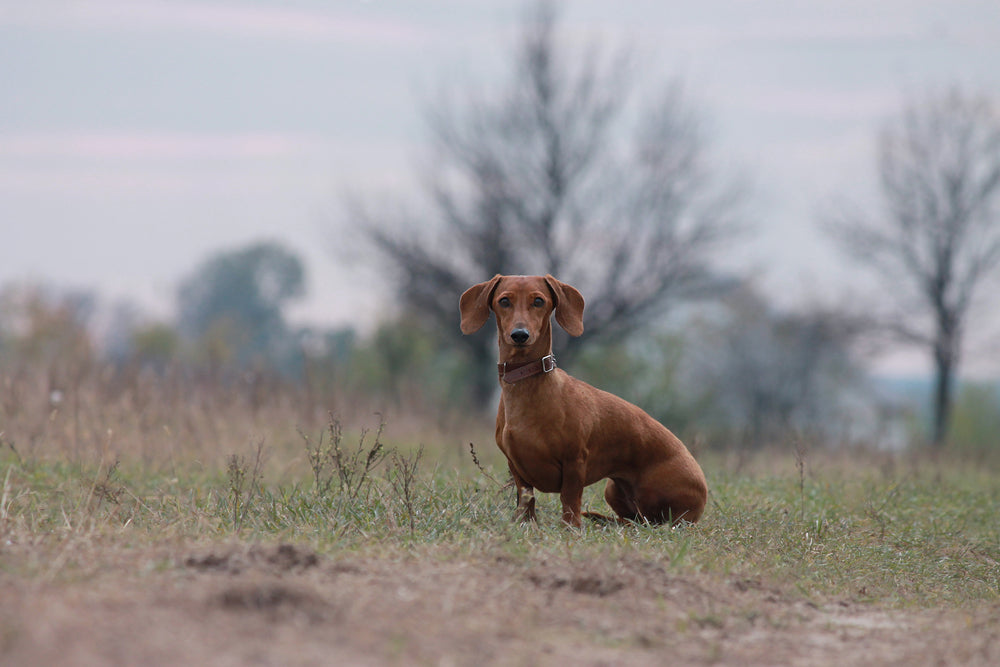
There are many theories about the origin of the dachshund, most of which have been debunked.
Due to images resembling dachshunds found in ancient Pharaonic Egypt, and the Egyptian word for these dogs "Tekal", some believe the ancestors of the dachshund lived during that era, but others think it is highly unlikely.
There have also been Assyrian reliefs of dogs resembling dachshunds, and dogs were described in ancient Greek literature just like the modern dachshund.
Some experts have hypothesized that the earliest roots of the dachshund date back to ancient Egypt, where engravings have been discovered depicting short-legged hunting dogs incredibly similar to the dachshund.
The American University in Cairo also recently discovered Egyptian funerary urns containing mummified dogs resembling dachshunds.
A zoologist named Brehm believed that the dachshund might have originated in Spain, as remains of a small dog of similar size were found in Peru, as well as in ancient Mexico. Even in Denmark, thanks to archaeological excavations, remains of short-legged dogs have been found.
The only thing that can be said with certainty is that small, short-legged dogs were bred in various parts of the world 🌎
The most commonly accepted theory is that the dachshund was created in Germany, which is considered its homeland. German cynologists Richard Strebel and Ludwig Beckmann conducted extensive research and, according to their findings, the dachshund is closely related to the German Bracke, or Deutsche Bracke.
This was confirmed by another German specialist, Hilzheimer, who found the remains of two dachshunds during archaeological excavations of a Roman military camp in Kannstadt, Germany.
The most likely theory comes from the German Fritz Engelmann, who believed that the dachshund was initially a harrier dog and was only later used to enter dens for hunting, or for tracking.
The Dachshund in the Modern Era
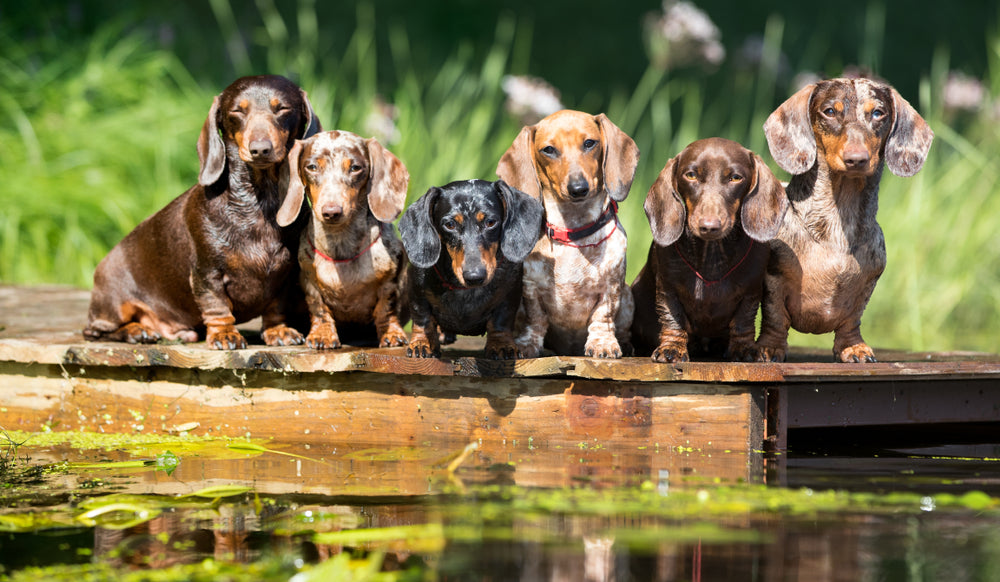
The dachshund breed has evolved over time. The dachshund we know and love today is strongly linked to dogs bred in 15th-century Germany, but it was perfected in the late 19th century.
German breeders devoted time and effort to restoring the wire-haired dachshund, which had virtually disappeared by the end of the 19th century. It was also at this time that the breed standard for size, coat, and color was established, belonging to group 4 (with working trial) 😊
Dachshunds were introduced to the United States in the 1880s and first became popular in the United Kingdom in 1840. They were brought back by the royal family for pheasant hunting.
Queen Victoria was apparently very fond of the breed, which contributed to its popularity. From the moment the royal family brought dachshunds to the UK, they became popular dogs with individuals, becoming companion pets.
Sociable and affectionate, dachshunds continued to be regarded by the royal family. As a reminder, Queen Elizabeth has a "Dorgi", after one of her corgis mated with a dachshund.
Modern dachshunds are slightly smaller than those originally bred in Germany in the 17th century. However, many of their characteristics and behaviors are the same, with retained endurance and liveliness, not to mention their powerful bark 🐶
History of dachshunds during the war
The dachshund has traditionally always been seen as a symbol of Germany in the minds of many people.
During World War I and World War II, the popularity of dachshunds declined due to their association with Germany, and political cartoonists used the breed's image to ridicule Germany.
In America, the dachshund breed was accepted into the AKC (American Kennel Club) in 1885, along with 14 other breeds.
Unfortunately, many years later, the dachshund almost disappeared in America due to its status as a symbol of Germany. People truly hated Germany and wanted to get rid of everything German, including the little sausage dogs they had previously valued so much.
The incredible result was that the number of dachshunds in America dropped to only 12 surviving dogs in 1919! People walking their dachshunds were attacked in the street, and dogs were killed everywhere.
For a short period in the United States, they were called "liberty hounds" or "badger dogs", much like the term "liberty cabbage" for sauerkraut in North America, in an attempt to reduce the association with Germany.
Nowadays, the dachshund is considered a positive symbol of Germany.
In 1972, when the Olympic Games were held in Munich, Germany, a dachshund named Waldi was the official mascot 😃

Waldi was the first official mascot in the history of the 1972 Summer Olympic Games and he is obviously a sausage dog! 🥰
This dog is well known for its endurance, tenacity, and agility. That is why it was chosen.
Waldi displays several different colors, and his striped body bears at least three of the six Olympic colors.
Waldi was born during a Christmas party for the Munich Games Organizing Committee, where participants were given colored pencils, sheets of paper, and modeling clay to create a mascot project.
This famous mascot had a real-life alter ego, a dachshund called "Cherie von Birkenhof".
The dachshund is a popular dog breed today
Today, the dachshund is as much a family pet as it is a hunting dog.
Due to its hunting past, it presents both advantages and disadvantages for the average pet owner. It is loyal and protective of its masters, and if it gets bored, it can easily dig up your entire garden or easily overturn your sofa cushions 😜
Although the dachshund can be one of the coolest and most adorable friends of your life, it remains a dynamic and athletic hunting dog.
Take care to think carefully if you are ready to provide the dachshund with what it needs to be the extraordinary dog it can be!
The Teckelshop Team - 💚 last modified on 05/03/26

Waldi Source:
https://olympics.com/fr/olympic-games/munich-1972/mascot


3 comments
Martin
Merci pour ces informations. Le teckel est une race que j"adore
Marie Migliorero
Article très documenté et intéressant
J’ai des teckels depuis 40 ans.
J’en ai 4 actuellement, c’est une race extraordinaire !
Merci pour votre article
Jeanne Rome
Merci beaucoup pour cet article très instructif et intéressant.
Leave a comment
All comments are moderated before being published.
This site is protected by hCaptcha and the hCaptcha Privacy Policy and Terms of Service apply.