

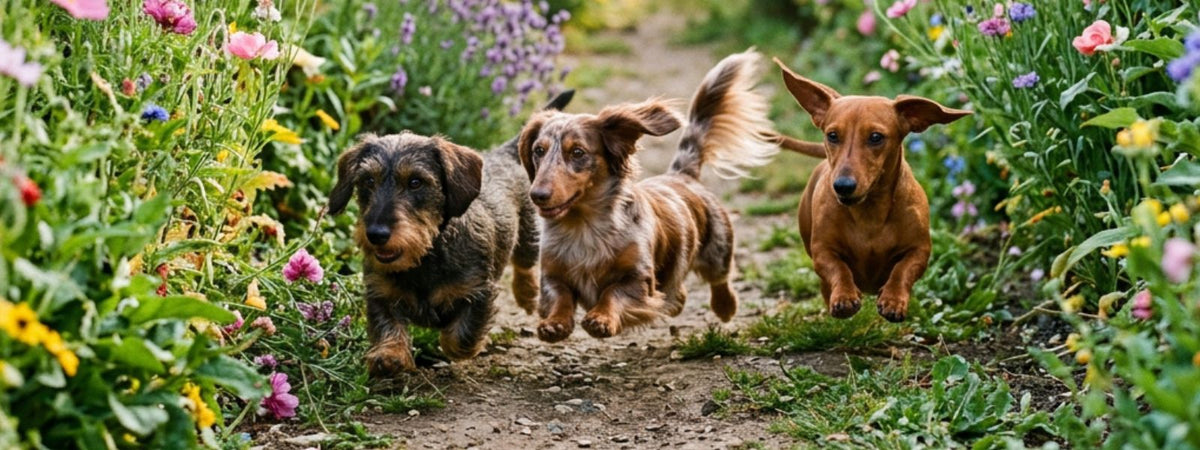
Does my dachshund really understand what I’m saying?
What my dachshund really understands: words, tone, body language, and context
Without analyzing grammar, your sausage dog excels at the art of decoding human communication. He simultaneously perceives four channels of information that owners tend to overlook.
Your dachshund doesn't just understand certain words...
VOCABULARY: Thanks to repeated associations, he can recognize a vocabulary of about 50 to 100 words. Therefore, always use the same term to refer to a specific action.
TONE OF VOICE: He is also very sensitive to the tone of your voice and perceives the emotion hidden behind your words. Your intonation often counts for more than the sentence itself.
BODY LANGUAGE: Even when you aren't speaking, he observes your posture, your expressions, and the direction of your gaze. Your little buddy reads you constantly, even in silence.
CONTEXT: Finally, he memorizes your habits. The simple act of picking up your keys or choosing certain shoes can allow him to anticipate what is going to happen, long before you speak to him.

Dr. Stanley Coren sets the average at 165 words and signals recognized by an adult dog. The most receptive ones reach up to 250. And in both cases, it is the tone of your voice that he captures first, even before the meaning of the word.
In your home, if you use a stable vocabulary, your dachshund will quickly retain about a hundred vocal cues. But even before the first word, it is the emotion in your voice that he intercepts. Relief, hesitation, or anxiety are perceived in a split second.
Does my dachshund understand what I'm saying: the intelligence of the solitary hunter
In the book The Intelligence of Dogs by Dr. Stanley Coren, the breed is relegated to the "average" category of working intelligence. This classification proves quite reductive: it evaluates mechanical obedience to repeated commands, not the overall mental finesse of the animal.
Passive obedience or strategic decision?
Shaped over centuries to go underground to face badgers, the dachshund was bred to act with complete autonomy. In a dark burrow, deprived of any human instruction, he had to analyze the situation, evaluate the danger, and make a decision on his own. Unlike a sheepdog chosen to guide a flock on direct command, your short-legged companion possesses an intelligence of initiative.
Why does my dachshund look at me as if he understands everything?
Research by Brian Hare, Michelle Brown, Christina Williamson, and Michael Tomasello, published in Science in 2002, shows that dogs even outperform great apes in reading human signals: gaze, gesture, intention. This ability isn't acquired; it was selected over millennia of domestication.
Kaninchen, miniature, standard: slight nuances
While the three official varieties recognized by the Fédération Cynologique Internationale (FCI)—the Kaninchen (rabbit), miniature, and standard—share this same insightfulness, their temperaments have slight subtleties. The miniature and kaninchen varieties sometimes prove more reactive to vocal signals, while the standard dachshund retains a more marked independence of judgment.

Does my dachshund understand what I'm saying: 5 habits for better communication with my dog
To transform this sensitivity into companionship during your life with your dachshund, a few adjustments to your habits make all the difference.
1. One unique word per intention
Choose a precise term and stick with it. If you say "come" at home when he approaches the couch, keep exactly that same word "come" at the park if he wanders off a bit too far.
If you suddenly use "here" or "arrive," your hunting dog perceives a new sound signal that he must analyze, which slows down his reaction.
2. Condensed messages
Ban long-winded sentences. The word "ball" is clearly much clearer than "would you like to go get your ball?"
In the evening in the living room, instead of telling him "come on sweetie, we're going to go to bed now," just say "bedtime." By removing unnecessary noise around the command, your companion instantly isolates the key word and complies without hesitation.
3. Aligning intonation
Always associate the intention with the appropriate tone. A command given with a smile lacks clarity for him.
If he approaches your plate at the table, a firm "no" in a neutral and calm intonation will be immediately understood. Conversely, telling him "no" in an affectionate voice while petting him sends two contradictory messages: he will remember the petting and the warmth of your voice, not the refusal.
4. Pre-established eye contact
Catch his gaze before formalizing your request. This direct signal indicates to him that the message is specifically intended for him and validates that his attention is fully yours.
Before asking him to wait on the sidewalk, gently say his name and wait for him to turn his eyes toward you. Once eye contact is established, give your command. Without this prerequisite, his natural curiosity pushes him to stare at a pigeon or another dog, and your word is lost in his environment.
5. Reinforcing the association
Praise spontaneous understanding rather than imposing physical restraint. This strengthens his emotional security and encourages his natural willingness to cooperate.
When he returns to you at the park at the first call, congratulate him warmly with a pet or a treat at the exact moment he arrives beside you. If you catch him by grabbing his collar without rewarding him, he will associate his return with an unpleasant end to the game instead of a moment of sharing.
What your dachshund says to you in return
Communication works both ways.
If you talk to him every day, your Doxie also expresses himself continuously with his body:
-
Ears slightly pulled back show you an attitude of attentive listening or slight reservation when faced with a new situation.
-
A soft gaze accompanied by slow blinks is a direct signal of appeasement, trust, and deep attachment to his owner.
-
A full body stretch upon waking serves as a ritual to greet you and start the day together.
-
A long sigh while settling in against you simply indicates that he feels he is right where he belongs, protected by your side.
Your dachshund doesn't decipher the syntax of your sentences. He translates the sincerity of what you express when you speak to him. And that is precisely why every detail of his environment matters: the bed in which he recovers, the throw under which he falls asleep against you, the ramp he uses to join you on the couch, or even the harness for the morning walk.
Discover the latest Teckelshop new arrivals®, carefully selected to accompany every moment of your life together.

FAQ - Does my dachshund understand what I’m saying?
Does my dachshund understand his name?
Yes, if you have used it consistently since his arrival. He associates this sound with your attention directed toward him and learns to respond to it through positive conditioning.
Are dachshunds intelligent?
Yes, but their intelligence is often misjudged. Bred to hunt alone and make autonomous decisions, they are less geared toward obedience than toward initiative. It is a different form of intelligence, not an inferior one.
Why does my dachshund ignore me when I call him?
Several reasons: the word isn't sufficiently associated with a positive consequence, the tone doesn't capture his attention, or he is focused on something else. Consistency and immediate reward make the difference.
Does my dachshund understand that I love him?
He doesn't understand the word "love." But he feels your emotions, memorizes your affectionate habits, and builds emotional security based on your presence. That is his way of understanding.
Does my dachshund understand what I am saying when I leave?
He doesn't understand "I'll be back in two hours," but he picks up on the signals that precede your departure—keys, jacket, shoes—and associates them with your absence. Modifying these rituals can reduce his separation anxiety.
--
And what about you—which words or sentences does your dachshund seem to understand best? Share your experiences and his funniest reactions in the comments!
Virginia, from the Teckelshop team - 💚

1 comment
Josseline
Je n’ai jamais eu d’autres chiens que des teckels. Au début des standard poils ras noir et feu, puis des nains et jusque 4 à la fois. Maintenant en vieillissant ne prends des retraitées d’élevage poils durs.
Tous mes teckels ont compris des mots. Toujours les mêmes. Quand je pars je dis « 5 minutes » (bon autour de moi on me traite de menteuse !), pour la gamelle (d’ailleurs c’est plutôt ces gourmands qui réclament !) je dis « croquettes » même si ce n’est pas le contenu de l’assiette ; pour partir en balade c’est « promener », même vétérinaire je préviens et c’est « docteur picpic ! Ma chienne actuel adore jouer. Elle a 5 jouets qu’elle m’apporte sur demande : pieuvre, doudou, poisson, noeud (tressé) et bien sûr baballe. Si je rajoute couic couic elle le mord pour faire couiner.
Tous ont été habitués aux mêmes rituels !
Je dis que je n’ai jamais eu de chiens mais des teckels !
Et tous ont été habitués à cohabiter avec des chats !
Qui va oser me dire qu’un teckel n’est pas intelligent ??? Bon ok intelligent … et têtu 😂
Leave a comment
All comments are moderated before being published.
This site is protected by hCaptcha and the hCaptcha Privacy Policy and Terms of Service apply.