

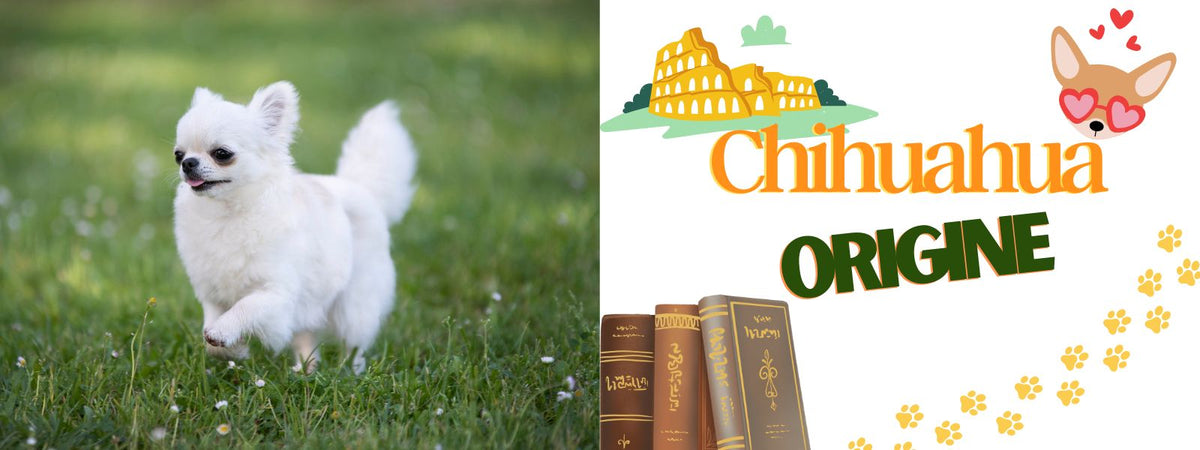

Like many modern dog breeds, the origin of the Chihuahua is shrouded in mystery.
Where does the Chihuahua come from? Was it imported from Europe? Does it descend from another breed? Was it bred for a specific purpose like hunting rodents or herding livestock?
Although there is no definitive answer to these questions, historians have concocted several theories about the history of the Chihuahua that we will explore in this new article. 😊
The State of Chihuahua, Mexico

Historians continue to speculate on the true origins of the Chihuahua, but most agree that they trace back to the state of Chihuahua in Mexico 🇲🇽.
Spanning 247,460 km2 and bordering Texas and New Mexico to the northeast, Chihuahua is the largest of Mexico's 32 states.
This is where dog enthusiasts reportedly discovered some of the first Chihuahua specimens in the mid-1800s.
In 1884, Mexican merchants began selling this small dog (puppy and adult) to tourists at the border, many of whom took them back to the United States as pets. At the time, this small, sociable pooch had no official name.
People instead named it based on the region in which it was observed.
This is how the modern Chihuahua came to be called the Arizona dog, the Texas dog, the Mexico dog, and the Chihuahua dog.
Of course, only one of these names stood the test of time, with the breed now universally recognized as the Chihuahua (dog breed).
The Ancient Techichi Dog Theory
Historians generally accept the idea that the origin of the Chihuahua dates back to Mexico in the late 1800s. It is what happened before that period that continues to spark debate.
One of the most plausible theories is that the Chihuahua is a descendant of the Techichi, a small companion dog domesticated by several pre-Columbian Mesoamerican civilizations and Native American tribes in North America.
With an average weight of 5 to 10 kg, the Techichi is about twice as large as the Chihuahua, but it shares many physical characteristics with its counterpart.
Unlike the Chihuahua, it is believed that the Techichi was mute and only had a long coat (the Chihuahua has a short and long coat).
Chihuahua and Maya and Toltec Civilizations

Following this theory, we can assume that the Mayans (1800 BC to 900 AD) or the Toltecs (900 AD to 1150 AD) were the first to domesticate the Techichi.
The Mayans considered dogs to be guardians of the afterlife, using them in burial ceremonies and as a source of food.
They often sacrificed, mummified, and buried dogs alongside their respective owners, believing that their canine companions would join them in the afterlife.
The Mayans even had nine different words for dog in their language, some of which referred to specific varieties.
It is unknown which breeds the Mayans domesticated, but historians believe it was at least the Techichi and the Xoloitzcuintli (Xolo).
When archaeologists uncovered ancient burial pits in Colima, Mexico, they discovered effigy pots and sculptures dating back to 300 BC depicting a dog with striking similarities to the Chihuahua!
Archaeologists also discovered dog toys on wheels in Central America dating back to 100 AD, depicting apple-headed and deer-headed varieties.
These were likely two variants of the Techichi, suggesting a direct link to the strain of today’s Chihuahua.
Another piece of evidence reinforcing the Techichi theory can be found in a 1,200-year-old Mayan figurine depicting a woman holding a child in one hand and a small dog with Chihuahua-like characteristics in the other.
This figurine is housed at Tulane University in New Orleans.
The Mayan civilization began to decline around 800 AD, giving rise to the Toltecs in 900 AD. And like their predecessors, the Toltecs also domesticated dogs for food and sacrificial purposes.
Archaeologists have discovered Toltec sculptures of small dogs with rounded, apple-shaped heads and erect ears, presumably Techichi.
The Aztecs and European Explorers

- The Aztecs
The Aztecs considered the Toltecs the perfect example of a civilization, following many of their predecessors' traditions, including human and dog sacrifices.
To appease their gods, they sacrificed humans during blood-offering ceremonies. If humans were unavailable, the Aztecs sacrificed dogs, including the Techichi.
Like the Mayans, Toltecs, and other Mesoamerican cultures, the Aztecs believed that sacrificed dogs joined their masters in the afterlife.
Furthermore, they believed that illnesses could be transferred from humans to dogs, thereby healing the human.
- The European Explorers
The Spanish conquistador Francisco Hernandez (died 1515) wrote that the Techichi was used as a food source by the Aztecs, in the same way the Spanish ate rabbits.
Other accounts written by European explorers describe how the Aztecs domesticated and used the small, tawny Techichi as pets.
The Spanish Jesuit missionary José de Acosta (1540 to 1600) described the Aztecs, who were then believed to be Indians, feeding dogs and keeping them as companions.
Another possibility is that Chihuahuas originated in Europe, specifically on the island of Malta.
Nestled 80 km below Italy, this Mediterranean island was once home to a small dog, the Maltese pocket dog, which shared a distinct characteristic with the Chihuahua: an opening in the skull, also called a molera or soft spot.
Between 80 and 90% of Chihuahuas are born with this undeveloped cranial opening.
DNA and the origin of the Chihuahua
A recent study on the DNA of this small canine breed could shed light on the origin of the Chihuahua.
Researchers from the KTH Royal Institute of Technology in Stockholm, Sweden, sought to study the origins of several current American dog breeds, including the Chihuahua.
For the study, researchers compared the Chihuahua's mitochondrial DNA with that of Asian dogs, European dogs, and samples from archaeological sites to see if there was a link.
The researchers found no link between the Chihuahua and Asian or European dogs.
They did, however, discover the Chihuahua's unique DNA type in samples from pre-Columbian Mexico, suggesting that the breed—or perhaps its Techichi ancestor—was present in Mexico before the arrival of European explorers.
The Modern Chihuahua

One of the first detailed accounts of the origin of the Chihuahua is that of James Watson, a dog judge and writer who immigrated from Scotland to New York in the 1870s.
During a trip to San Francisco to attend a dog show in 1888, Watson stopped in El Paso and crossed the Mexican border to investigate rumors about this widely discussed breed.
There, he bought a Chihuahua, which he later named Manzanita, from a Mexican merchant for $5.
Watson returned shortly after to buy several more Chihuahuas, including one of the breed's first champions, Juarez Bell. He wrote about his new companions in The American Kennel Register and Country Life in America, describing them as being small enough to fit in his pocket.
The Smooth-Coat Chihuahua
In the 1890s, the President of Mexico gave the famous French-Italian opera singer Adelina Patti a bouquet of flowers in which a small short-haired Chihuahua was hidden.
Patti immediately felt a bond with her new canine companion and took Bonito across the country during her tours.
At the time, many people had heard of Chihuahuas but had never seen one. Patti changed the course of Chihuahua history by introducing this small, affectionate, and amusing breed to the world.
It was not until 1904, however, that a resident of Texas registered the first Chihuahua, Midget, with the AKC (American Kennel Club).
During that same year, three other Chihuahuas were registered with the AKC. And a few years later, the AKC had its first champion. By 1915, 30 Chihuahuas were registered with the AKC.
The Chihuahua Club of America (CCA) was founded in 1923 to promote the breed and provide educational resources on health, grooming, and general characteristics.
In 1952, the CCA separated the breed into two different varieties: smooth/short-coat and long-coat, just like the FCI in France (group 9, companion and toy dogs).
In Conclusion
The Chihuahua dog breed of all sizes (including the dwarf or toy) is also very popular in the UK, Canada, Mexico, and Australia.
In 2013, this affectionate pet ranked 4th on the list of most registered breeds of the Fédération Cynologique Internationale (FCI).
Today, the cute Chihuahua consistently ranks among the most popular small dog breeds in the world!
Finally, let us know in the comments below if you are surprised by the origins of your beloved watchdog. 😊
- The Teckelshop Team - We are dachshund fans but remain in love with all canine breeds 💚🐶



Leave a comment
All comments are moderated before being published.
This site is protected by hCaptcha and the hCaptcha Privacy Policy and Terms of Service apply.