

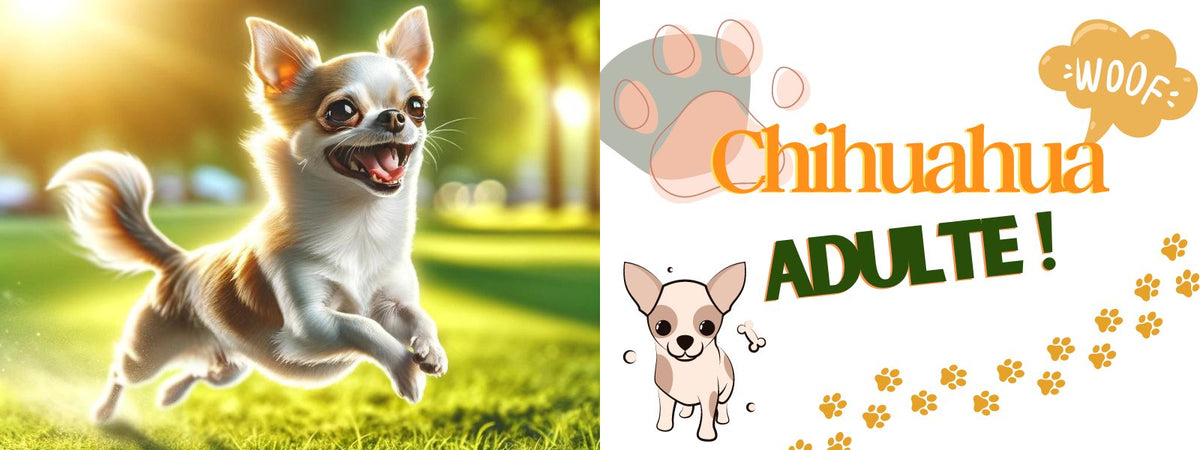
In this new article, we want to cover all elements related to the adulthood and growth of the magnificent Chihuahua dog!
Let's take this opportunity to quickly point out that a Chihuahua has 2 coat types according to the FCI (Fédération Cynologique Internationale):
- Long-coat Chihuahua
So if you are ready to learn more about how the world's smallest dog grows, you are in the right place, and don't hesitate to check out our article on Chihuahua prices! 🥰

The youngest age to adopt a Chihuahua puppy
In some cases, a Chihuahua puppy may be a bit older before leaving for its new home.
Furthermore, it may happen that a breeder (specializing in breeding) feels that a Chihuahua has not grown as expected and, being a little too small, wishes to wait an extra week or even a month to allow the puppy to gain a little more weight. 🤗
If a small puppy needs to be transported over a long distance to a new home, by car or other means, some breeders will want the Chihuahua to be older, up to about 3 months, to be able to better manage the physical and emotional stress that can develop during the trip.
The different growth stages in a Chihuahua's life

🐶 One-day-old newborn:
Chihuahua puppies are born with their eyelids closed, their hearing is not yet developed, and their milk teeth have not yet emerged. Newborns just sleep and nurse.
🐶 10 days:
Most puppies have doubled their birth weight.
Sleeping and nursing take up 95% of the little Chihuahua's day.
🐶 1 month:
This is the beginning of the "socialization phase" for the puppy, during which acceptance or fears are formed.
The puppy must be handled often and must be able to explore safely, and growth is rapid at this time. Weaning begins! (gradual transition from nursing to solid food).
🐶 6 weeks:
Milk teeth begin to appear 😍
Weaning is well underway, and the puppy is starting to manage solid food. The first round of vaccinations is administered.
🐶 2 months:
Most puppies are ready to join their new homes.
Although this is a huge adaptation, it is also an exciting time for a canine. A Chihuahua puppy of this age can easily be frightened by something, but their fears are not yet deep-seated.

The arrival of the Chihuahua in its new family
Part of your job as a new puppy owner is to take advantage of the young Chihuahua's natural curiosity and gradually introduce a wide range of stimuli.
This includes touching its teeth (for future dental cleanings), coat brushing, exposure to all sorts of household noises, and introducing toys that will be useful when the teething phase begins.
Deworming is done at 8 weeks, and a combination vaccine will be given at 8 or 9 weeks. Potty training begins.
At this age, the Chihuahua puppy sleeps a lot, 18 hours on average, both at night and during naps. Growth is therefore rapid on the way to adulthood. 🐾
🐶 3 months:
This is the beginning of the educational phase during which the puppy learns its place in the household hierarchy. Your goal should be to have your adolescent see you as the alpha (the leader) of the den (the house). 😃
A certain understanding of hierarchy will be acquired by a Chihuahua puppy who observes you. However, now is the time to clarify your leadership and train your Chihuahua! Otherwise, any type of training can be difficult, and behavioral problems may occur, including territorial marking...
Its appetite begins to grow, the puppy's vaccinations are finished or almost finished, and you can then start taking it for walks twice a day and letting it play in the yard (always under supervision).
Potty training for the young pup is still ongoing, but there should be progress. The dog stays awake more often during the day and does better at sleeping through the night.

At this young age, it's a real little ball of hyperactive energy, and by playing with it, you'll be able to teach it many good habits! 🥰
🐶 4 months:
At this age, its training is still ongoing, and the small dog is now much more aware of its surroundings.
The young dog may protest by barking when left alone more than when it was younger... and separation anxiety issues may appear or intensify.
Potty training is almost finished, and teething begins about now with stronger urges to chew.
👉 The French brand EVIDENT offers healthy and natural "deer antler" packs for dog chewing:

🐶 6 months:
This is the beginning of adolescence, and puberty is underway for both males and females.
If they are not spayed, females will have their first heat around this time.
Teething may calm down a bit while the hyperactive puppy behavior diminishes: this often brings a certain calm to the house, when things might have seemed a bit chaotic before 🤭
If canine training began at the age of 2 months, the puppy should now be completely potty trained. Growth is slowing down...!
🐶 9 months:
Most Chihuahuas stop growing around the age of 9 or 10 months.
For others, they will just gain a little weight until about 12 months, and teething is finished or almost finished.
1 year: benchmark age

That's it! A Chihuahua is considered to have reached adulthood with a weight between 1 and 3 kg. 🥳
The one-year-old young adult is alert, active, and wants to stay active. It has, however, less hyperactive behavior.
🐶 1 1/2 to 9 years:
The Chihuahua is in its prime, and you can start regular grooming to take care of its coat, paws, claws, teeth, ears, etc... 🥰
🐶 10 years and older:
There is no exact age at which a dog is declared a senior.
Since small dogs live relatively long lives, they become seniors later than large dogs.
The veterinarian who is well-acquainted with a pet's health history declares when a dog is senior (but generally, we refer to 10 years).
Your affectionate pup will adopt a diet adapted to its adult health, and your veterinary specialist will continue to advise you on its energy needs and kibble brands.
Age equivalence between Chihuahua and human

The idea that a dog ages 7 years for every human year is a generalization 😉
This idea was put forward some time ago, assuming a human life expectancy of about 70 years and a dog's of about 10 years.
In reality, dogs age at different rates, with their breed size being the determining factor.
Small dogs mature much faster than larger dogs and have longer life expectancies. Furthermore, it is a myth to think that the Chihuahua is a fragile dog despite its small size.
A dog's growth rate is not the same at all stages of its life. For toy dog breeds, we observe rapid maturation growth during the first year equivalent to 15 years, then a jump equivalent to 9 years for the second year, and then things level off in 4-year increments.
Final paw
Here are the maturity stages of this little ball of love that is intelligent: 🐶
- Newborn: From birth to 4 weeks.
- Puppy: 4 weeks to 1 year; can be divided into young puppy (4 weeks to 5 months) and older puppy (6 months to 11 months).
- Adult: 1 year, can be divided into young adult (1 to 4 years) and adult (5 to 9 years).
- Senior: 10 years and older.
Tell us in the comments below how old your pet dog is, we want to know! 😉
- The Teckelshop Team - We are fans of dachshunds but remain in love with all dog breeds 💚🐶



2 comments
Giner
Mon chihuahua à 9 mois cela lui fait quel âge en personne ? Merci beaucoup
Boyé
6 mois
Leave a comment
All comments are moderated before being published.
This site is protected by hCaptcha and the hCaptcha Privacy Policy and Terms of Service apply.